









What Comes After Sport?
3 Min Read
What Comes After Sport?
Two weeks before the World Cup, the first legal doping games quietly forced a dangerous question about the future of sports.
Years ago, we were approached about a potential meeting with Lance Armstrong and his investment fund.
The context was interesting.
They wanted to explore investing in one of our projects.
This was already years after the doping scandal that shook the sports world and completely changed how many people looked at him.
On paper, the meeting probably made sense.
His name still opened doors.
There was likely real business potential there.
And there was still something undeniably fascinating about the story around him.
But after a relatively short internal conversation, we decided not to do it.
The meeting never even happened.
Not because of money.
Not because of logistics.
There was simply a deep discomfort around what he represented at that moment.
It felt like the story had become bigger than the person himself.
And honestly, that memory came back to me over the past few weeks as the Enhanced Games story started spreading across the sports world.
Because my first reaction was probably similar to many others inside traditional sports:
Discomfort.
Resistance.
Almost instinctive rejection.
And honestly, that reaction is understandable.
For more than a century, global sport has been built on ideas that matter deeply:
fairness, integrity, rules, governance, legacy, and the belief that competition should operate inside clear boundaries.
Which is exactly why I think the sports industry should pay attention to what is happening right now.
Not because the Enhanced Games are necessarily the future of sport.
But because they may be revealing something important about where sport, attention, performance and audience behavior are already heading underneath the surface.
In less than a month, the sports world will shift into full World Cup mode.
Sponsors, broadcasters, leagues, brands, creators, media companies and billions of fans will all focus on one thing:
the biggest FIFA World Cup in history, across the United States, Mexico and Canada.
At almost the exact same moment, another sports event quietly entered the global conversation from Las Vegas.
Not from FIFA.
Not from the IOC.
Not from a traditional league or federation.
But from a completely different world:
Silicon Valley.
Biotech.
Creators.
Private capital.
And the growing obsession with optimization.
The event is called the Enhanced Games.
At first glance, it feels easy to dismiss.
The headlines almost write themselves:
“Steroid Olympics.”
“Doping Games.”
“A circus.”
But the more I looked at the story over the past few days, the more convinced I became that many people are focusing on the least interesting part of it.
This is not really about doping.
It is about signals.
Signals about where attention is moving.
Signals about how younger audiences increasingly consume performance.
Signals about the collision between sport, entertainment, technology and identity.
And signals about a much bigger question quietly forming underneath the surface:
What exactly does the next era of sport look like?
Because the timing here is not random.
Over the next two years, North America will become the center of the global sports universe:
- The biggest FIFA World Cup in history
- The Olympics coming to Los Angeles
- Formula 1 transforming Las Vegas into a global entertainment platform
- Creator-led sports formats continuing to grow
- Netflix-style storytelling reshaping fan behavior
- AI entering every layer of performance and media
- Private capital aggressively moving into sports ecosystems
At the exact moment traditional sports institutions are trying to protect legacy and stability, a completely different model of sport is starting to emerge from the edges.
A model built less around governance, and more around attention.
Less around institutions, and more around platforms.
Less around preserving tradition, and more around maximizing engagement.
Because whether the Enhanced Games ultimately succeed or fail is almost secondary.
The more important question is:
why did a concept like this suddenly generate so much global attention right now?
I don’t think the answer is “because people want doping.”
I think the answer is that modern audiences increasingly consume sport differently than the industry itself still assumes.
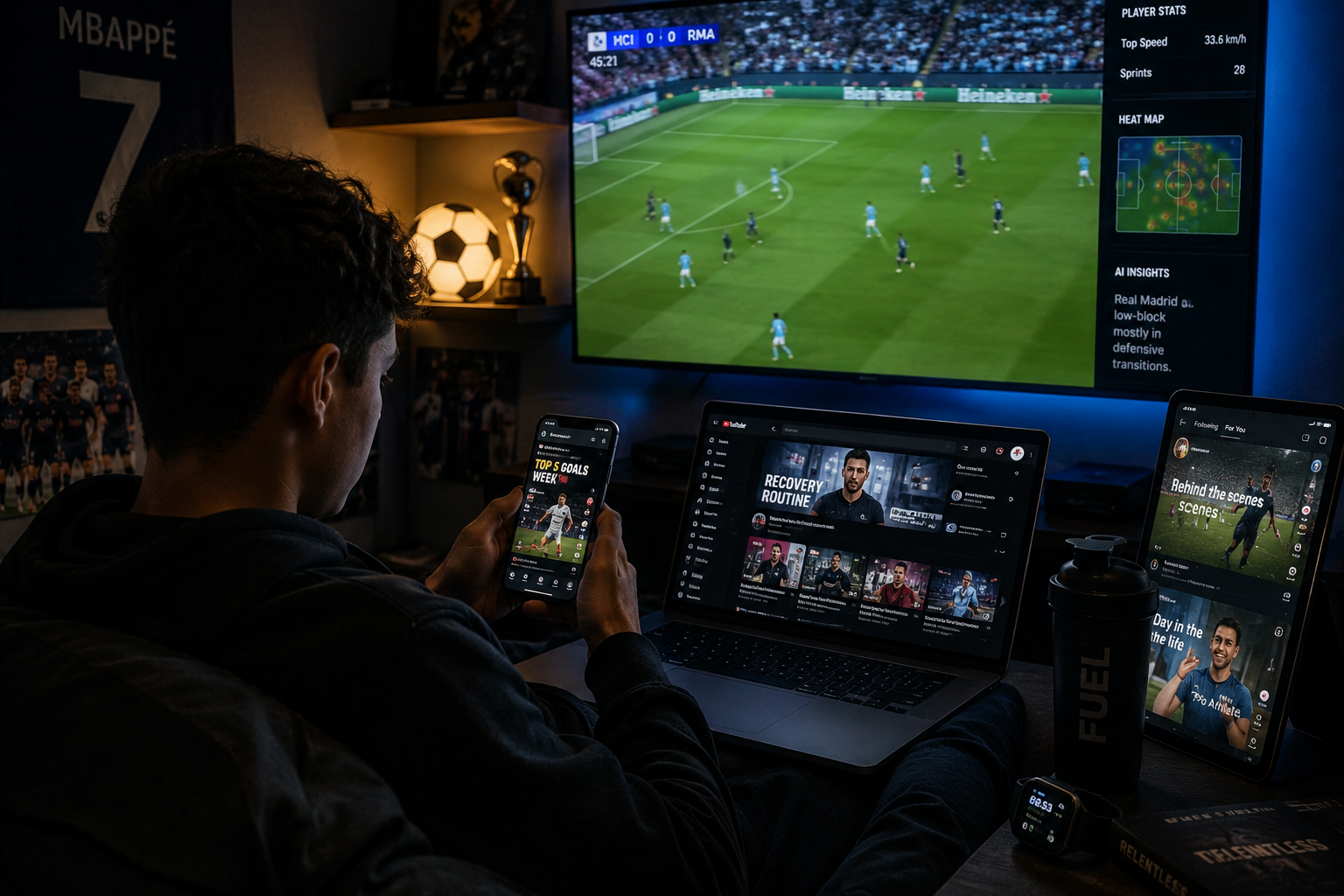
A 16-year-old sports fan today may spend more time watching creator clips, behind-the-scenes athlete content, recovery routines and YouTube analysis than actually watching full live matches.
That sentence alone should probably make every sports executive pause for a moment.
Younger audiences now grow up in a world of:
- algorithmic feeds
- creators
- personalization
- behind-the-scenes access
- performance tracking
- short-form emotional storytelling
They do not separate sports, entertainment, technology and identity as cleanly as previous generations did.
To them, performance itself is becoming content.
And increasingly, performance is becoming culture.
That shift is already visible everywhere:
- Formula 1 becoming a storytelling platform through Drive to Survive
- creator-led leagues attracting millions of young viewers
- the rise of recovery and wearable ecosystems
- fans becoming obsessed with optimization itself, not only results
- athletes evolving into media brands and performance businesses
The Enhanced Games did not create these trends.
They simply pushed them to an uncomfortable extreme.
And that is exactly why traditional sports organizations should pay attention.
Not because the future of sport is enhancement.
But because concepts like this expose where audience behavior, fan psychology and attention economics may already be heading beneath the surface.
The real risk for traditional sports is not sudden collapse.
FIFA is not disappearing.
The Olympics are not disappearing.
Major leagues are not disappearing.
The real risk is slower, quieter and much harder to detect:
That younger audiences gradually begin building emotional connections differently than previous generations did.
History shows this rarely happens overnight.
Attention slowly migrates first.
Economics usually follow later.
That may ultimately become the most important question raised by the Enhanced Games.
Not:
“Should this exist?”
But:
Five Uncomfortable Realities Traditional Sports Leaders May Need To Face
1. Sports Is No Longer Competing Only Against Sports
For decades, sports organizations understood competition relatively clearly.
A club competed against another club.
A league competed against another league.
A broadcaster competed for rights.
That world is disappearing.
Today, sports competes against:
- TikTok
- YouTube
- Netflix
- gaming
- creators
- infinite algorithmic feeds
Attention is no longer guaranteed.
And younger audiences increasingly evaluate sports the same way they evaluate every other form of entertainment:
- Does it engage me emotionally?
- Does it move fast enough?
- Does it feel personal?
- Does it create conversation?
The Enhanced Games understand this deeply.
Traditional sports organizations often still underestimate it.
2. Younger Fans Increasingly Value Access Over Tradition
One of the biggest assumptions inside sports has always been that legacy itself creates loyalty.
Historically, that was true.
But younger audiences increasingly connect differently.
They want:
- access
- intimacy
- behind-the-scenes visibility
- transformation stories
- creator personalities
- emotional transparency
Not only polished broadcasts and institutional messaging.
Tradition still matters.
But tradition alone may no longer be enough.
Especially for audiences raised in the creator economy.
3. Performance Is Becoming A Consumer Economy
This may be one of the most underestimated shifts in sports today.
Performance is no longer something fans only watch.
Increasingly, it is something they want to experience personally.
The explosion of:
- wearables
- sleep tracking
- recovery technology
- AI coaching
- longevity culture
- optimization platforms
shows that millions of consumers are becoming obsessed with improving themselves.
WHOOP reportedly built a business worth billions by turning recovery and performance tracking into identity and lifestyle.
That should make every sports property think carefully about where fan engagement may be heading next.
The future sports fan may not only want to watch elite performance.
He may increasingly want to participate in it.
And that changes the opportunity landscape dramatically for clubs, brands, sponsors, broadcasters and startups alike.
4. Attention Increasingly Rewards Emotional Energy
One reason concepts like the Enhanced Games spread so quickly is simple:
They trigger emotion.
Traditional sports organizations sometimes protect professionalism so carefully that they unintentionally remove emotional intensity from the product itself.
But modern attention systems reward:
- tension
- narrative
- personality
- transformation
- conflict
- unpredictability
This is part of the reason:
- Formula 1 exploded culturally through storytelling
- creator sports continue growing
- sports documentaries outperform expectations
- behind-the-scenes content drives engagement globally
The real competition in sports is no longer only for trophies.
It is increasingly for attention, emotion and cultural relevance.
5. The Center Of Gravity In Sports May Slowly Shift From Institutions To Platforms
For more than a century, the sports industry was shaped primarily by institutions:
federations, leagues, governing bodies and broadcast networks.
Increasingly, the future may be shaped by platforms:
- creator ecosystems
- technology companies
- performance platforms
- direct-to-consumer communities
- AI-driven engagement systems
This does not mean traditional sports disappear.
Far from it.
But it may mean the center of gravity slowly shifts toward whoever understands changing audience behavior fastest.
And that shift may already be starting.

Final Thoughts
Maybe the Enhanced Games fail completely.
Maybe they disappear within a few years.
That’s entirely possible.
But history shows that fringe concepts sometimes matter less because of what they become, and more because of what they reveal early.
And right now, they may be revealing something uncomfortable:
That sport itself may be evolving faster than many of the institutions built around it.
I’m still not sure where all of this leads.
And honestly, part of me hopes some boundaries in sports never disappear completely.
But I’m increasingly convinced that what emerged in Las Vegas matters less because of the event itself, and more because of what it quietly exposed underneath the surface:
A generation of fans whose relationship with performance, identity, entertainment and sport may already be changing faster than the industry itself fully realizes.
The Enhanced Games are not challenging the Olympics.
They are challenging the assumptions behind modern sports.
With the Love for Sports and Innovation,
AR
CEO, HYPE Sports Innovation
P.S. We still have few final seats left for the World Cup Roadshow. If your solution is already working with customers and you’re thinking “we should probably be there”… 🙂 write to Jeanette at je******@hy******************.com.



Comments
NannyBombeshell
Interesting piece. The point about attention shifting outside traditional institutions really resonates. You see it in grassroots movements too, where communities like roller skate nation https://roller-skate-nation.pissedconsumer.com/review.html thrive without any federation backing. Maybe the future of sport is less about governance and more about these organic, passion-driven spaces. Thanks for sharing this.