









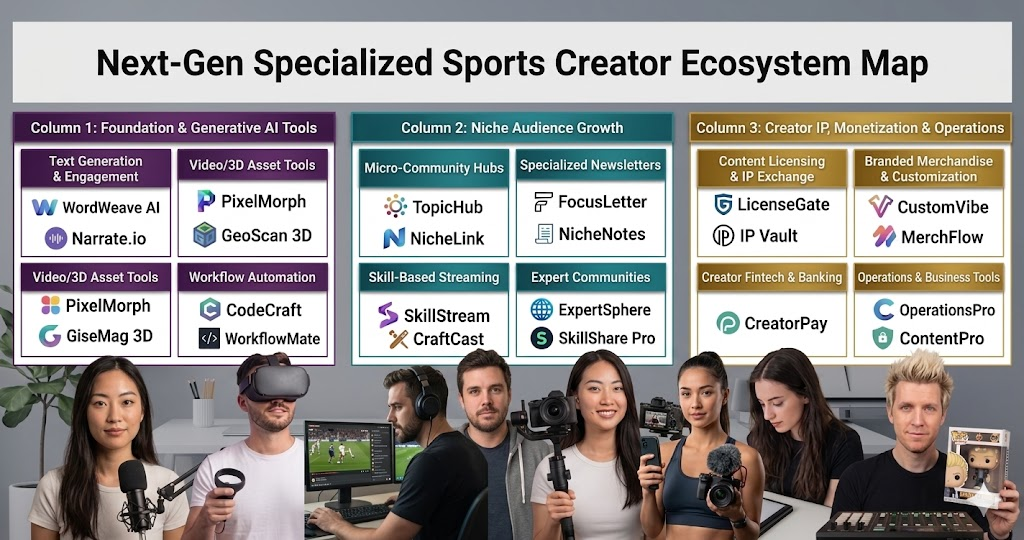
Sports Has Entered The Creator Era.
3 Min Read
Sports Has Entered The Creator Era.
And Most Of Sports Is Completely Unprepared.
Is the Creator Era Taking Over Sports?
The global sports industry is projected to become an $8.8 trillion industry by 2050.
But the biggest transformation happening inside sports right now is not only financial.
What is happening around the 2026 World Cup is not a marketing trend.
It is a structural shift in how sports culture, fandom and emotional connection are being built.
Most of the industry still underestimates how deeply this transformation may reshape media, sponsorship, fan engagement and the future economics of global sports itself.
The 2026 World Cup will become the first truly global sports event where creator ecosystems are fully embedded into how the tournament itself is experienced, distributed and remembered.
Not at the edges of the event.
At the center of it.
A football creator in Brazil may generate more engagement around certain moments than regional sports networks.
A tactical football creator on YouTube or TikTok may influence how millions of young fans understand a match more than post-game television analysis.
A creator-led fan community on Discord may become more active during certain matches than official broadcaster engagement platforms.
A player’s behind-the-scenes vlog during the tournament may generate more emotional connection than the official marketing campaign around the team itself.
A gaming streamer may become the emotional entry point into football culture for millions of young fans.
A creator in Seoul may shape global conversation around player identity, tunnel fits and football culture faster than traditional media.
FIFA has already announced few partnerships with Creators platforms around the tournament.
Creators are being given access to behind-the-scenes content, training sessions, press conferences, archive footage and cultural moments surrounding the event.
Major brands are increasingly building campaigns around creators and social-native storytelling rather than traditional advertising alone.
Even traditional media organizations are beginning to integrate creators directly into the sports experience itself.
The matches will still dominate global attention.
But much of the emotional experience surrounding the tournament will increasingly happen through creators:
real-time reactions, behind-the-scenes access, fan communities, tactical breakdowns, player stories and millions of pieces of creator-led content shaping how younger audiences experience the World Cup.
The game remains at the center.
But the story around the game is no longer controlled by broadcasters alone.
And that may become one of the biggest shifts in modern sports history.
For the first time in modern sports history, broadcasters and leagues are beginning to lose monopoly over how fandom is created.
Because the next generation of sports fans is not experiencing sports the way previous generations did.
They are experiencing it through creators, communities, algorithms and culture.
Because the next generation of sports growth will not be driven only by broadcasting deals.
It will be driven by relevance, relationship and emotional connection.
And emotional connection is increasingly being rebuilt around creators.
The Industry Shift Beneath The Surface
The global sports industry is entering one of the biggest growth periods in its history.
Women’s sports are accelerating.
Streaming is reshaping consumption.
Sports betting continues to expand worldwide.
Private equity is flowing aggressively into sports properties.
Technology, media and entertainment are converging faster than ever.
On the surface, this looks like a traditional growth story.
Bigger leagues.
Bigger audiences.
Bigger sponsorships.
Bigger broadcasting deals.
But underneath the surface, something much more important is happening.
The way fandom itself is created is changing.
For decades, sports organizations operated inside a relatively stable model of emotional loyalty.
Fans inherited clubs through geography, family and local identity.
Broadcasters controlled distribution.
Leagues controlled access.
Media companies shaped the narrative around the game.
That system created some of the most powerful sports brands in history.
But the next generation of fans is entering sports differently.
Fast.
They do not experience sports only through live matches or traditional media windows.
They experience sports through clips, creators, algorithms, communities, podcasts, reactions, memes and culture.
The future fan may not inherit a club.
They may discover one.
Through a creator.
Through a community.
Through culture.
And that changes the economics of sports far more than most people realize.
Over the past two years, I’ve had more conversations with sports executives discussing creators, community and cultural relevance than traditional digital strategy.
Privately, many already understand what the industry still struggles to admit publicly:
Younger audiences are emotionally connecting to sports in very different ways than previous generations did.
Creators Are No Longer Marketing. They Are Infrastructure.
For years, most sports organizations viewed creators as a promotional layer around the game.
A way to generate additional reach.
A social media tactic.
A campaign strategy.
That mindset is becoming dangerously outdated.
Many organizations still treat creator ecosystems as marketing strategy.
That may become one of the most expensive misunderstandings in modern sports.
Because this shift is not about influencer marketing.
It is about how future fandom is built.
Creators are no longer amplifying sports culture from the outside.
They are shaping it from within.
Across every major sport, leagues, clubs and athletes are giving creators unprecedented levels of access:
locker rooms, training grounds, behind-the-scenes moments, live events, player interactions and creative freedom that traditional media rarely had.
But the most important shift is not access.
It is function.
Creators are now part of the infrastructure of modern sports fandom.
They translate the emotion of sports into thousands of communities, identities and niches simultaneously.
A gaming creator brings football culture into gaming audiences.
A fashion creator transforms tunnel arrivals into global style moments.
A comedy creator turns sports narratives into internet culture.
A business podcaster reframes athletes and clubs through entrepreneurship and ownership.
For decades, sports controlled attention by controlling access.
The internet changed access.
Creators changed emotional connection.
And emotional connection has always been the real engine of fandom.
The next generation may build stronger emotional connection with creators discussing sports than with the institutions behind the sports themselves.
That possibility changes the power structure of sports media entirely.
Because the future of sports fandom may be shaped less by who owns the rights and more by who owns the relationship.
The future of sports may belong less to whoever owns the broadcast and more to whoever owns the audience relationship.
Sports Organizations Are Becoming Entertainment Ecosystems
The rise of creators is not happening in isolation.
It is forcing sports organizations themselves to evolve.
Because the modern sports fan no longer engages with sports only during the match itself.
They engage continuously.
Daily.
Year-round.
Across platforms, formats and communities.
That changes the role of sports organizations entirely.
For decades, the business model of sports revolved around live events and broadcasting windows.
Today, that model is expanding into something much bigger.
Leagues, teams and athletes are increasingly behaving like entertainment companies.
They are building studios.
Launching documentaries, podcasts and digital series.
Partnering with streaming platforms.
Investing in creator-led content.
Expanding storytelling far beyond the field itself.
Formula 1’s growth through Drive to Survive may be one of the clearest signals of this shift.
The series did not simply create more viewers.
It transformed Formula 1 from a racing property into a year-round cultural product.
That distinction matters.
Because the next generation of sports growth may come less from the live event itself, and more from the surrounding universe of stories, personalities, creators and communities built around it.
The match is still the centerpiece.
But it is no longer the entire product.
Broadcasting built modern sports.
But broadcasting alone may not build what comes next.
Sports is no longer competing only against other sports leagues.
It is competing against Netflix, YouTube, TikTok, gaming, streaming and every other form of digital entertainment fighting for cultural relevance.
In that world, relevance becomes a daily battle.
Not a weekly one.
The Athlete Is Becoming A Media Company
One of the clearest signals of where sports is heading may be coming from the athletes themselves.
Especially the next generation.
The rise of NIL in college sports revealed something much bigger than a monetization opportunity.
It revealed a new mindset.
Young athletes no longer see themselves only as performers inside a sports system.
Increasingly, they see themselves as brands, creators, businesses and media platforms from day one.
Audience ownership is becoming part of the modern athlete playbook.
Not after retirement.
Not after championships.
From the very beginning.
Because emotional connection is becoming leverage.
An athlete with a highly engaged audience now carries value far beyond performance alone.
Sponsorship power changes.
Commercial influence changes.
Media value changes.
Negotiating power changes.
The next generation of athletes will not only build careers on the field.
They will build ecosystems around themselves:
content, communities, podcasts, brands, partnerships and direct fan relationships.
Many clubs and leagues are no longer investing only in athletes.
They are investing in audience ecosystems.
Because modern fandom is becoming deeply personality-driven.
For younger audiences especially, emotional attachment increasingly begins with people before institutions.
The Risk Nobody In Sports Wants To Talk About
The biggest threat facing sports organizations over the next decade may not be financial.
It may be cultural.
For decades, sports benefited from something incredibly rare:
Guaranteed emotional attention across generations.
Very few industries in the world ever had that advantage.
What makes this moment so important is that, for the first time, that emotional connection is becoming contestable.
The next generation is not building emotional connection to sports the way previous generations did.
They are discovering sports through creators, algorithms, clips, personalities, communities and internet culture.
That creates enormous opportunity.
But it also creates a dangerous possibility.
Large sports organizations can remain commercially successful while slowly becoming less culturally relevant to younger audiences.
Some organizations will continue generating billions while slowly disappearing from youth culture.
Legacy alone will not protect sports organizations from cultural irrelevance.
History alone will not guarantee relevance.
Because relevance today is earned daily.
Inside feeds.
Inside communities.
Inside culture.
Not only inside stadiums.
The sports industry still underestimates how fast cultural power is decentralizing.
Especially among younger audiences.
Sports is no longer competing only for viewership.
It is competing for cultural relevance inside people’s daily lives.
That is the real risk.
Not revenue collapse.
Cultural irrelevance.

Final Thoughts
The future fan may not inherit a club the way previous generations did.
They may discover one.
Through a creator.
Through a community.
Through a cultural moment online.
That changes the architecture of sports forever.
Because for decades, sports controlled attention by controlling access.
The internet changed access.
Creators changed emotional connection.
And emotional connection has always been the real engine behind sports.
The sports industry is not simply growing.
It is being rebuilt.
Around creators.
Around storytelling.
Around entertainment.
Around culture.
Around emotional connection.
The organizations that understand this shift early will not simply build larger audiences.
They will build the next generation of global fandom.
When the world watches the next World Cup, billions of people will still watch the matches.
But millions will experience the tournament through entirely different cultural layers built by creators.
And that may become one of the most important shifts in modern sports history.
Because the future of sports will not be decided only on the field.
It will be decided inside culture.


Comments
Victor Houston
I really appreciated your insights on how sports are evolving with the creator era. It’s fascinating to see athletes stepping into creative roles, much like how I’ve found myself engaging more with games like fnaf. The community-building aspect of these platforms mirrors what you described about athletes connecting with fans personally.