










Sports Has Been Measuring the Wrong Thing
3 Min Read
Sports Has Been Measuring the Wrong Thing
“Why Participation Capital Will Become the Most Valuable Asset in Sports?”
A few years from now, sports executives may look back and realize they spent two decades measuring the wrong thing.
The numbers looked great.
Reach was growing.
Views were growing.
Followers were growing.
Engagement was growing.
Every dashboard suggested progress.
Every board meeting reinforced the same belief:
More attention equals more value.
That assumption built some of the most successful sports businesses in the world.
It may not build the next generation.
For a long time, that belief was right.
Then the world changed.
Content became abundant.
Attention became harder to earn.
Communities became harder to build.
And loyalty became harder to keep.
The response was predictable.
Create more content.
Launch more channels.
Publish more posts.
Produce more highlights.
Optimize for more reach.
But what if sports organizations have become so good at producing content that content itself is no longer the advantage?
And what if a handful of organizations figure this out before everyone else?
Because if they do, they won’t simply gain an advantage.
They’ll build an entirely different kind of moat.
One that becomes stronger as AI makes content cheaper, faster, and increasingly abundant.
If you’re responsible for a club, league, federation, media company, brand, investment fund, or sports technology business, this isn’t a theoretical question.
It may become one of the most important strategic questions of the next decade.
A Simple Idea About Feeling Alive
Last year, a short essay called Aliveness and Where to Find It spread rapidly across the internet.
Not because it introduced groundbreaking research.
Not because it introduced a new technology.
Because it gave people language for something they already felt.
Its premise was remarkably simple.
Ben James divided human activity into four categories:
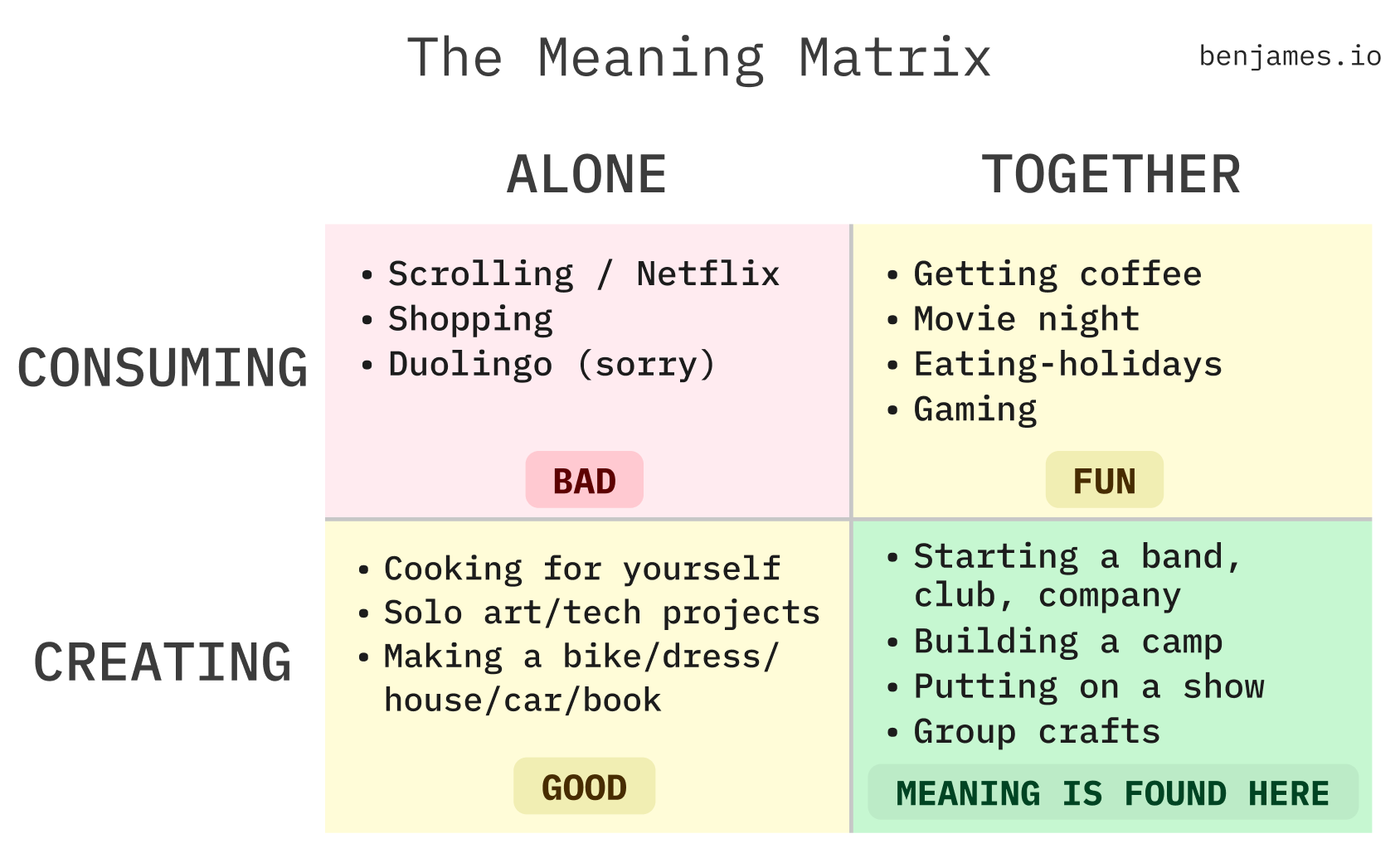
His insight was straightforward.
Most of us move between all four quadrants.
But the moments that feel most meaningful, memorable, and alive tend to happen in one place:
Creating together.
Not consuming alone.
Not even consuming together.
Creating together.
The framework resonated because people immediately recognized it.
Most could point to the moments in their lives that felt the most meaningful.
A company built with friends.
A community they helped grow.
A project bigger than themselves.
In almost every case, they weren’t consuming.
They were creating together.
What makes the framework so powerful isn’t that it explains where people have the most fun.
It explains where people find meaning.
And if that’s true for individuals, it raises an interesting question for sports.
What if the organizations creating the most long-term value aren’t those generating the most content?
What if they’re the ones helping the most people create meaning together?
What Ben James described as a source of personal fulfillment may also help explain one of the most important shifts happening in sports.
Because if people naturally seek experiences that move them from consumption to participation, perhaps sports organizations have been measuring the wrong thing all along.
The Attention Trap
For the past twenty years, sports organizations have optimized for attention.
The logic was obvious.
Attention drove media rights.
Attention drove sponsorship.
Attention drove growth.
As a result, the industry became exceptionally good at measuring:
- Reach
- Views
- Followers
- Impressions
- Watch Time
- Engagement
These metrics aren’t wrong.
They simply measure consumption.
They tell us who watched.
Who clicked.
Who looked.
They tell us very little about who contributed.
Who participated.
Who helped create value.
While the industry was measuring attention, a different asset was quietly becoming more valuable.
Most organizations simply weren’t measuring it.
The industry didn’t become obsessed with the wrong metrics because it made a mistake.
It became obsessed with them because they worked.
Until they didn’t.
Then AI Changed the Equation
Every technological revolution follows the same pattern.
Something becomes abundant.
Something else becomes scarce.
That’s where value moves.
The internet made information abundant.
Social media made distribution abundant.
AI is making content abundant.
Soon, every sports organization will be able to generate unlimited articles, highlights, commentary, analysis, and personalized experiences.
The cost of content creation is rapidly approaching zero.
Which leads to a question many leaders still haven’t asked:
If everyone can create content, what becomes valuable?
The answer may define the next decade of sports.
Participation.
The more content AI creates, the more valuable human participation becomes.
Not less.
More.
For the first time in history, sports organizations may be facing a strange reality:
The easier it becomes to create content, the harder it becomes to create belonging.
And wherever belonging becomes scarce, value follows.
Because sports is one of the few industries built around something technology cannot replicate:
People experiencing something together.
The World Cup Is Showing Us the Future
If you want to see Participation Capital in action, you don’t need a case study.
You only need to look at the World Cup.
Every four years, the sports industry believes it is witnessing the greatest content event on Earth.
Every four years, it is reminded that people are willing to cross oceans to participate in something bigger than themselves.
We’re seeing it right now.
Billions can watch World Cup matches from home.
The broadcasts are exceptional.
The highlights are instant.
The statistics are endless.
Yet hundreds of thousands of fans still travel extraordinary distances to be there.
They spend thousands of dollars.
Wait in airports.
Stand in lines.
Miss sleep.
Miss work.
Why?
Not for content.
The content is available everywhere.
They travel for participation.
Because participation turns an event into a memory.
And a memory into meaning.
To be part of the atmosphere.
Part of the emotion.
Part of the story.
We often describe the World Cup as the world’s biggest content platform.
It isn’t.
It’s the world’s biggest participation engine.
And that distinction matters.
Because it offers a glimpse into where the entire industry is heading.
The Signals Are Everywhere
The World Cup isn’t an exception.
It’s a signal.
One of many.
Fantasy Premier League
Fantasy football transformed passive viewers into active participants.
The matches didn’t change.
The audience did.
People stopped simply watching.
They started competing, deciding, tracking, sharing, and engaging.
Participation increased.
So did value.
Strava
Strava’s success isn’t built on tracking activity.
Many platforms can do that.
Its success comes from turning individual exercise into collective participation.
It transformed activity into community.
Running Clubs
One of the fastest-growing movements in sports today is surprisingly simple.
People running together.
Not because they need another app.
Not because they need more content.
Because they want connection.
Because participation creates belonging.
The Rise of Participation Capital
Every era creates a defining asset.
The industrial era valued physical capital.
The knowledge economy valued intellectual capital.
The social media era valued attention capital.
If attention was the defining asset of the last era, what is the defining asset of the next one?
Participation Capital.
Participation Capital is the value created when people actively contribute to an ecosystem instead of passively consuming from it.
It grows when:
- Spectators become contributors
- Followers become participants
- Audiences become communities
- Consumers become creators
Unlike attention, Participation Capital compounds.
The more people contribute, the stronger the ecosystem becomes.
The stronger the ecosystem becomes, the harder it becomes to replicate.
And that’s where long-term value is created.
From Attention Capital to Participation Capital
| Yesterday | Tomorrow |
|---|---|
| Audience | Community |
| Reach | Contribution |
| Followers | Participants |
| Consumption | Creation |
| Engagement | Ownership |
| Attention | Participation Capital |
| Media Asset | Participation Asset |
For years, sports organizations competed on the left side of the table.
The next generation of leaders may win on the right
Three Predictions for 2030
1. Active Communities Will Outperform Passive Audiences
A community of 100,000 active participants will often be more valuable than an audience of one million passive consumers.
2. Participation Metrics Will Enter the Boardroom
Leading organizations will begin measuring participation alongside revenue, audience, and engagement.
Because participation will become financially material.
3. The Biggest Winners Won’t Be Content Companies
They will be participation companies.
Organizations that turn spectators into contributors will build stronger and more durable businesses than those focused solely on attention.
Final Thoughts

The Question That Matters
For years, sports leaders asked:
How do we create more content?
It was the right question for the previous era.
The next era demands a different one:
How do we help more people create together?
That question changes everything.
It changes fan engagement.
Community strategy.
Events.
Technology investments.
Partnerships.
Product design.
Leadership.
Because organizations that answer it successfully won’t simply attract attention.
They’ll build Participation Capital.
And that may become the most valuable asset in sports.
A few years from now, sports executives may look back and realize they spent two decades measuring the wrong thing.
The winners won’t be the organizations that captured the most attention.
They’ll be the organizations that inspired the most participation.
The organizations that turned spectators into contributors.
Audiences into communities.
Consumers into creators.
For the last twenty years, sports competed for attention.
The next twenty will be won by those who compound Participation Capital.
P.S.
The biggest risk in sports right now isn’t choosing the wrong solution. It’s missing the one your competitors discover first.
See the technologies selected by leading sports organizations, meet the people behind them, and learn how clubs, leagues, federations, broadcasters, and brands are already putting them to work.
Want to know more about it? Click HERE!
With the Love for Sports and Innovation,
AR
CEO, HYPE Sports Innovation



Comments
deiaxilr
Llevo varias semanas usando https://tonybet.cloud/cl/casino y la experiencia ha sido positiva. Hay miles de juegos de proveedores conocidos como Pragmatic y Play’n GO. El bono del 100% hasta 200.000 CLP más giros gratis es atractivo, aunque el requisito de apuesta hay que cumplirlo con paciencia. Los retiros tardaron un par de días, pero llegaron sin problemas. La interfaz es clara y el chat en vivo funciona bien. Ideal para quienes buscan variedad en un solo lugar.
Tina
Your idea about participation capital makes a lot of sense because sports are not only built on viewers, but on people who actually play, share, train, and bring friends into the culture. A kid joining a local league, a parent volunteering, or someone rediscovering skating as an adult can create more long-term value than one passive view. I once saved https://roller-skate-nation.pissedconsumer.com/review.html while comparing skate gear, and it reminded me how participation turns interest into identity. The future of sports may belong to brands that measure belonging, habits, community energy, and real involvement instead of attention alone.
Tim Lawler
Thanks for this. A very interesting perspective and one I agree with, particularly considering next generations. Participation itself will be redefined, but one hopes that continues to include a form of physical activity/participation where sport is concerned. I think the point about what is being measured is a crucial and topical one for the rise of women's sport, ie if we continue to measure its growth with the same metrics we have measured (mainly) men's sport - audience scale, commercial value, fan base, broadcast and sponsor value - then it will perpetually remain and perhaps be considered, unfairly, second to men's sport. In my view this is wrong. If we can define different success measures, eg audience profile, relatability (being easier to connect with), accessibility and so on then there may be an opportunity to create a different and very compelling proposition for investment - by fans and sponsors - in a different way. I'm not intending to have some sort of Jerry Maguire moment here, or to appear naive, but as you suggest, we need to explore some different perspectives and lenses for the future to avoid a sleep walk to banality and homogeneity. Tim