









FIFA May Still Own The World Cup. But It May No Longer Control It.
3 Min Read
FIFA May Still Own The World Cup. But It May No Longer Control It.
With nearly 3 billion people across India, China, and major parts of Asia potentially unable to access the 2026 World Cup through traditional legal broadcasting, the tournament could become sports media’s Napster, Netflix, and COVID moment all at once.
Most people think the story of the 2026 World Cup will be about the end of an era.
The last World Cup of Lionel Messi, Cristiano Ronaldo, Kevin De Bruyne, Luka Modrić, and perhaps the final chapter of an entire football generation that shaped the last two decades.
And they are probably right.
It will be emotional.
Historic.
Global.
But what most people still don’t realize is that this may also become the last World Cup experienced the way we traditionally knew World Cups at all.
Because beneath the football, something much bigger is beginning to shift.
The collision between sports broadcasting and internet behavior.
This is no longer only a FIFA problem.
It may become a defining moment for every:
- league
- club
- broadcaster
- streaming platform
- sponsor
- investor
- sports executive
- sports technology company
Because when billions of people are forced to change how they consume the world’s biggest live event, industries rarely stay the same afterward.
Music didn’t.
Television didn’t.
Work culture didn’t after COVID.
Sports may be next.
What makes this moment so important is that the disruption is not happening randomly.
It is happening inside some of the largest and most strategically important markets in the world.
In India, timing is becoming a serious issue.
Many matches played in North America will air deep into the night across Asia, weakening live viewership, advertising value, and broadcaster economics.
At the same time, India is expected to be heavily focused on another national obsession:
the Women’s Cricket World Cup.
That creates a direct war for attention, advertising budgets, distribution priorities, and audience behavior.
In China, the situation may be even more sensitive.
Broadcast discussions have reportedly reached the highest levels of government.
Unlike most Western markets, media distribution in China is tightly connected to national priorities and state influence.
There are growing questions around how much exposure authorities want to give to a month-long event dominated by Western media narratives, global sponsors, international advertising, and American cultural influence during a period of rising geopolitical tension.
This is no longer simply a media rights story.
It is becoming:
- a behavioral story
- a geopolitical story
- a technology story
- an internet story
And potentially one of the most important sports media turning points in decades.
COVID didn’t invent remote work.
Zoom already existed.
Slack already existed.
Cloud collaboration already existed.
COVID accelerated behavior change at global scale.
Almost overnight, billions of people changed how they worked, communicated, sold, collaborated, and built relationships.
And once behavior changed, the world never fully went back.
The same thing happened before.
Napster changed music consumption.
Netflix changed television behavior.
Uber changed transportation expectations.
The iPhone changed how humans interact with information.
The biggest consumer shifts rarely happen gradually.
They happen when old systems fail during massive global moments.
The 2026 World Cup may become that moment for sports media.
The warning signs are already everywhere
Streaming fragmentation is rising.
Subscription fatigue is growing.
Sports piracy is exploding globally.
Meanwhile, younger audiences increasingly consume sports through clips, creators, highlights, memes, watch-alongs, second screens, and algorithmic feeds rather than traditional broadcasts.
Sports broadcasting is colliding with internet behavior.
And the internet usually wins.
But the real story may not be piracy.
It may be convenience.
Every industry starts breaking the moment the unofficial experience becomes easier than the official one.
Napster was easier than buying CDs.
Netflix became easier than cable.
Uber became easier than taxis.
And now the unofficial sports internet is becoming faster, cheaper, more social, more global, more personalized, and more frictionless than the official one.
That changes everything.
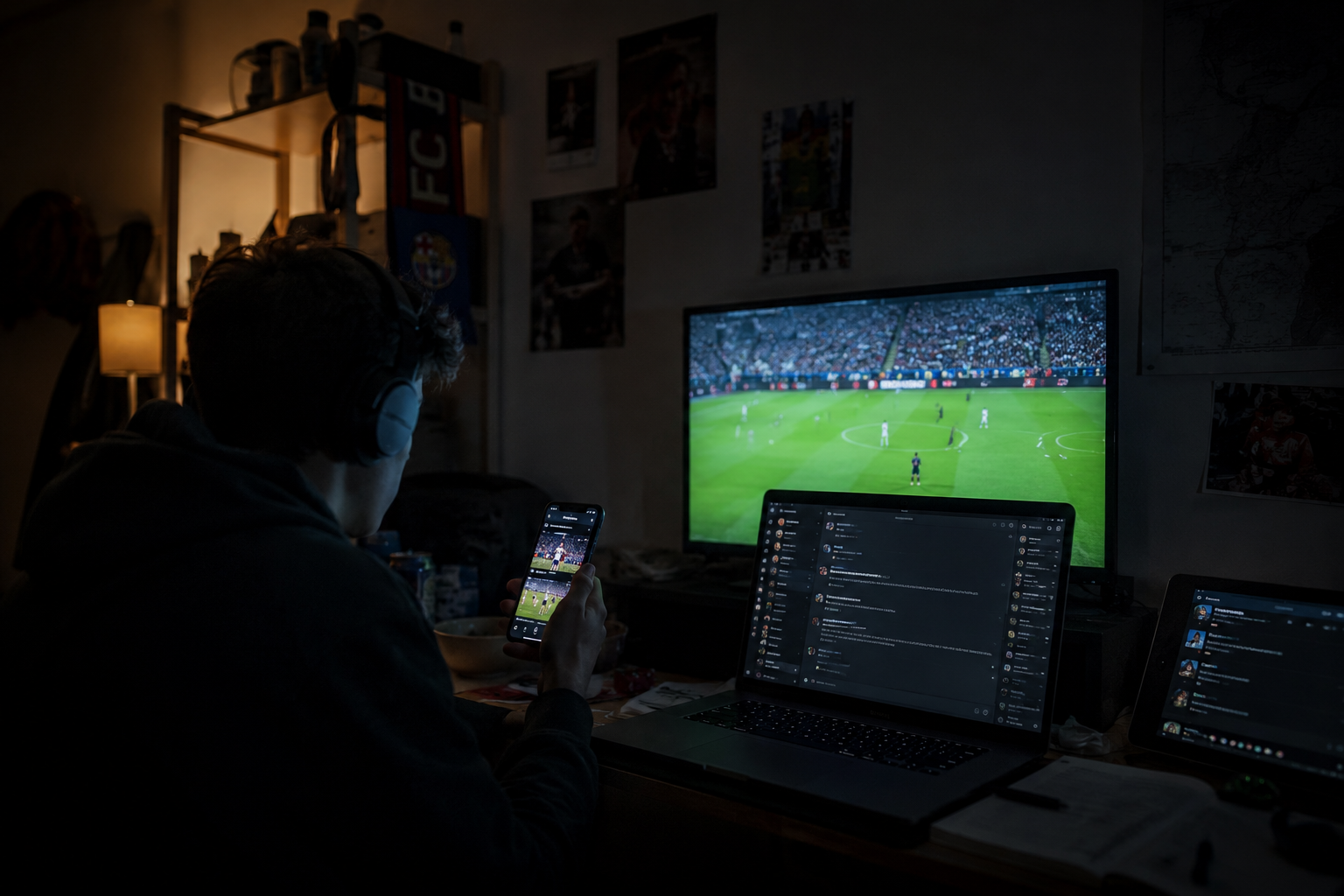
Somewhere during the 2026 World Cup, a teenager may experience the biggest sporting event on Earth entirely through clips, creators, AI-generated summaries, WhatsApp groups, TikTok reactions, Telegram streams, and Discord communities, without touching a traditional broadcaster once.
To him, this is already the World Cup.
Not television.
The internet.
And once behavior changes at global scale, industries rarely regain control completely.
That is the part sports executives should pay attention to.
Because the greatest threat to sports broadcasting may not be piracy itself.
It may be behavior migration.
The sports industry still talks about protecting rights.
The audience is already building new behavior around them.
And history shows that once consumer behavior moves at scale, industries rarely get to decide what happens next.
For the next generation:
- the clip may matter more than the full match
- the creator may matter more than the broadcaster
- community may matter more than the channel
- algorithmic discovery may matter more than scheduled programming
The match itself may no longer be the entire product.
The internet around the match may become more valuable than the match itself.
And then comes AI.
Because AI is about to accelerate all of this dramatically.
AI can already:
- generate real-time highlights
- personalize sports feeds
- translate commentary instantly
- create automated match summaries
- customize viewing experiences
- generate infinite sports content optimized for engagement
Which creates a radical possibility:
The 2026 World Cup may not produce one global experience.
It may produce billions of personalized ones.
Different creators.
Different feeds.
Different narratives.
Different emotional journeys.
For decades, sports broadcasting was built around synchronization:
one signal,
one feed,
one shared experience.
The internet is pulling sports toward fragmentation, personalization, creator-led commentary, community-driven consumption, algorithmic discovery, and AI-generated experiences.
The World Cup may become the first time the entire world sees this collision happen in real time.
FIFA may still own the rights.
But it may no longer control the behavior.
And that distinction matters more than most people realize.
Because every major media disruption starts the same way:
the infrastructure remains centralized,
while audience behavior becomes decentralized.
Music went through it.
Television went through it.
News went through it.
Sports may be next.

Final Thoughts
For decades, the sports industry operated on a relatively stable assumption:
Control the rights,
control the distribution,
control the audience.
That assumption may now be starting to break.
Not gradually.
Publicly.
Globally.
In real time.
Because if the 2026 World Cup accelerates large-scale behavioral migration toward creators, unofficial ecosystems, AI-generated consumption, fragmented viewing, community-driven distribution, and algorithmic discovery, then the implications will extend far beyond this tournament.
They could reshape:
- the future value of sports rights
- sponsorship economics
- streaming profitability
- club engagement models
- fan loyalty
- media strategy
- sports startup opportunities
- the economics of live sports itself
The real risk is not that fans stop watching.
The real risk is that they start watching differently.
And once consumer behavior changes at global scale, history shows it rarely returns to the old model.
The sports industry may still believe it is preparing for the next World Cup.
What if it is actually preparing for the last World Cup experienced the old way?
Because the next generation of sports fans may not inherit the sports media system the industry spent decades building.
They may replace it entirely.
With the Love for Sports and Innovation,
AR
CEO, HYPE Sports Innovation


Comments