









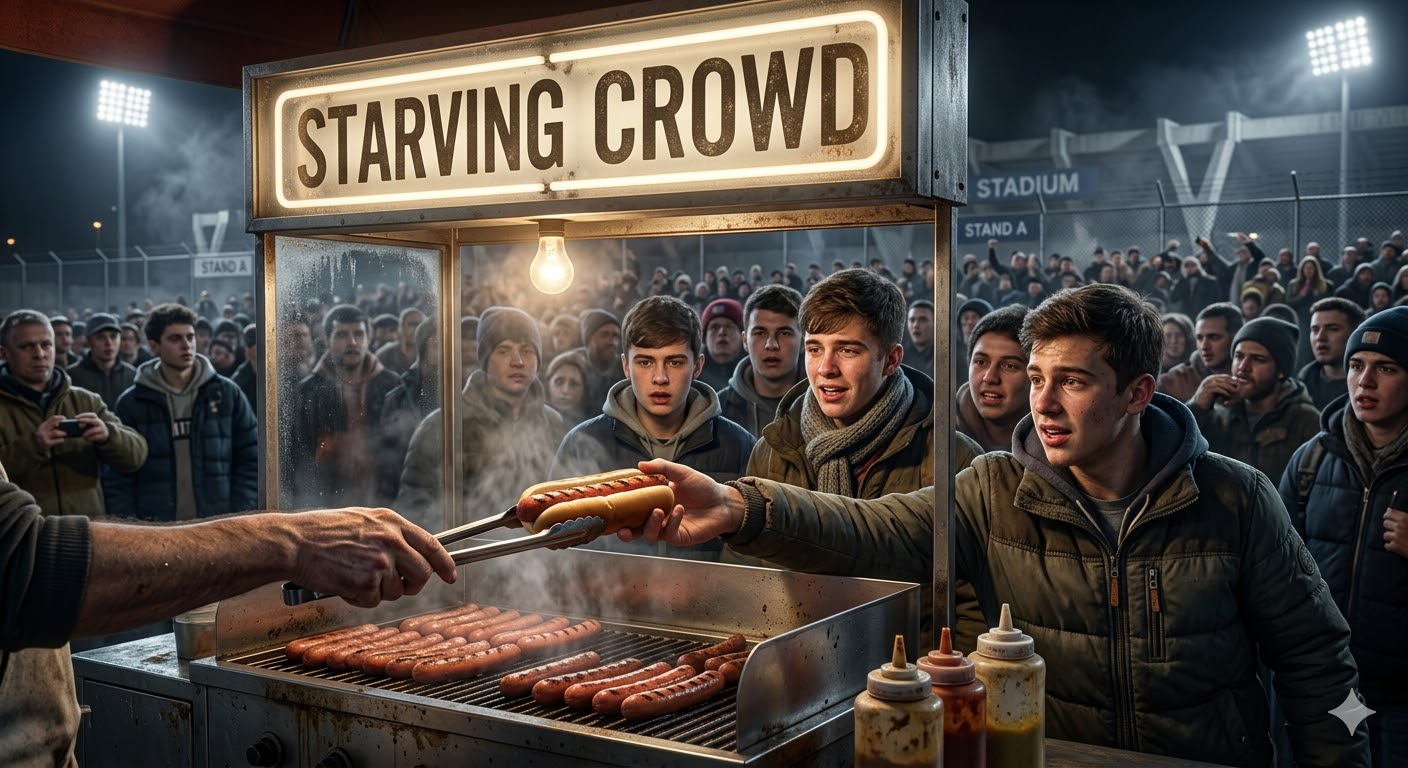
The “Starving Crowd”
3 Min Read
Why SportsTech Startups Don’t Have a Sales Problem
The issue is not sales, it is selling to people that are truly hungry for a solution
Walk out of a stadium after a big match and you will see something simple. that are truly hungry for a solution.
People are hungry.
At that moment, the food stand outside does not need a great brand, a great story, or even a great product.
It needs a starving crowd.
That is why people buy an average sausage in a bun without thinking twice. Not because the product is special. Because the hunger already exists.
That is the lesson.
Markets do not reward the best product in theory. They reward the product that meets real, urgent demand.
And that is where many sports tech startups go wrong.
They do not struggle because the technology is weak. They struggle because they are selling to a market that is not hungry enough, or describing their offer in a way that misses the buyer’s real pain.
Most startups are not losing because of product
They are losing because of positioning.
Founders talk about what they built:
- We improve fan engagement
- We optimize performance
- We bring AI to sports
- We deliver advanced insights
That may all be true.
It is still not what buyers wake up caring about.
A commercial leader wakes up thinking:
- I need more revenue
- I need to prove ROI
- I need faster results
- I cannot waste six months on another pilot that goes nowhere
A performance leader wakes up thinking:
- I cannot lose another key player to a preventable injury
- I need better workload decisions
- I need more players available
- I need fewer costly mistakes
That is the real market.
The founder sees the product.
The buyer feels the pressure.
Deals are won or lost in that gap.
Interest is not hunger
This is where many startups fool themselves.
You can get meetings, demos, compliments, and follow-ups and still have no real traction.
An interested market listens, asks smart questions, requests the deck, and says the product looks promising.
Then it disappears.
A hungry market behaves differently.
It asks:
- How fast can we start?
- What do you need from us?
- How will success be measured?
- What does this cost?
- Who needs to be involved?
That is a different conversation.
So when founders keep hearing:
“This is interesting.”
“Maybe later.”
“Let’s revisit after the season.”
It usually does not mean sales is the problem.
It means the pain is not sharp enough, or the offer is not framed around the pain that already exists.
Nice-to-have does not close
Sports tech is full of solutions that sound good on paper.
Better engagement.
Better insights.
More automation.
Smarter decisions.
More personalization.
Nice does not close.
Nice gets delayed.
Nice gets pushed to next quarter.
Nice gets stuck with someone who has no budget.
Nice dies when the season starts.
In sports, a product has to feel necessary, not interesting.
Sports organizations say they want innovation. In reality, they want certainty.
They buy when something solves a clear problem, fast, with limited disruption.
What this looks like in practice
A startup says:
“We help clubs improve fan engagement through AI-powered personalization.”
Sounds smart.
Still weak.
Why?
Because “fan engagement” often does not create enough urgency.
Now compare it to this:
“We help sports properties generate new revenue from existing fans in 60 days, without adding headcount.”
That lands differently.
Because it speaks to what the buyer already wants:
- revenue
- speed
- simplicity
- ROI
In the first version, you describe a category.
In the second, you sell relief.
And hungry markets buy relief.
This applies on the performance side too
The same principle applies to performance, injury prevention, workload, and return-to-play.
A startup might say:
“We use AI and wearable data to optimize athlete performance.”
Again, that may be true.
Again, it is too abstract.
A head of performance is not buying “optimization.”
They are dealing with:
- too many soft tissue injuries
- overloaded players
- unclear return-to-play decisions
- pressure to keep top players available
- fear of making the wrong call
So the stronger message is not:
“AI for performance optimization.”
It is something closer to:
“We help teams identify dangerous load patterns earlier, so they can reduce preventable soft tissue injuries.”
That is the real conversation.
Nobody is hungry for another dashboard.
They are hungry for fewer injuries, more availability, and fewer costly mistakes.
The better question
When startups get stuck, they often ask:
How do we explain the product better?
Usually, that is the wrong question.
The better questions are:
- Who is already in enough pain to move now?
- What problem do they already know they have?
- How much is it costing them?
- Who is measured on it?
- What happens if they do nothing?
- Do we sound like a must-have, or like innovation theater?
Those questions are harder.
They also get you closer to money.
The hard truth
Your product may be strong.
Your technology may be real.
Your team may be excellent.
You may still struggle to close deals.
Because markets do not pay for impressive.
They pay for relevant.
If your product is aimed at someone who does not feel enough pain, closing will be hard.
If you speak in abstract language while the buyer is living inside concrete pressure, closing will be hard.
If you sell a beautiful future instead of immediate relief, closing will be hard.

Final thoughts
In sports tech, technology does not win by itself.
A strong product in front of the wrong buyer will stall.
A real solution wrapped in vague language will stall.
A smart company talking to the wrong person will stall.
The market rewards pain alignment before sophistication.
That is why the starving crowd concept matters.
The goal is not to find more people to pitch.
The goal is to find the people who are already hungry, and frame your offer around the pain they are already living with.
That is where conversations change.
That is where pilots become commercial deals.
That is where a startup stops sounding interesting, and starts sounding necessary.
So here is the real question:
Where does the hunger already exist?
That is where the money is.
That is where urgency is.
That is where deals close.
With love for sport and innovation,
AR
CEO, HYPE Sports Innovation
P.S. If you’ve built something real, raised money, and already have customers, but deals are not coming fast enough, this may be relevant: “3 Deals in 90 Days”


Comments