










We Are Entering a Historic Shift in How Sports Decides What to Buy
3 Min Read
We Are Entering a Historic Shift in How Sports Decides What to Buy
The Sports Industry Is About to Learn a Brutal Truth About ROI
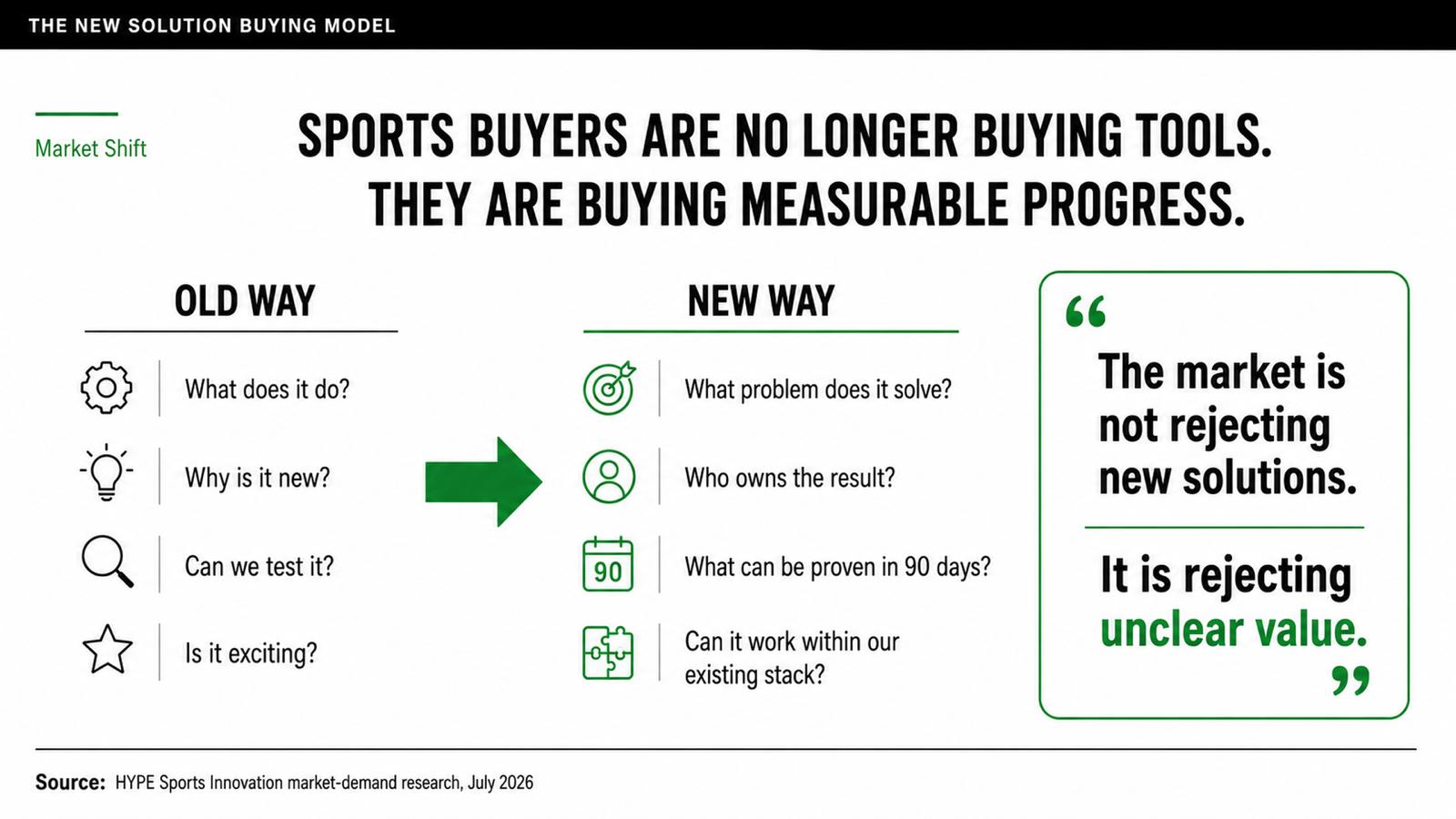
For more than a decade, the sports industry chased the next big technology.
We built innovation labs, startup programs, demo days, pilots, and entire strategies around AI, fan engagement, computer vision, immersive experiences, Web3, and digital transformation.
The assumption was simple: greater access to technology would make an organization more innovative.
That model delivered access. It did not always deliver adoption.
Today, the biggest bottleneck in sports innovation is no longer access to technology. It is the ability to convert technology into measurable value.
Teams, leagues, federations, venues, media companies, and global brands are changing the questions they ask before committing budget, data, people, and reputation to a new solution.
Which result will improve?
Who owns that result?
How will the solution work with the systems we already use?
How quickly can we produce evidence strong enough to act?
This is more than a change in language. The buyer is taking back control.
In recent months, we have watched brilliant technologies lose momentum for one simple reason: nobody could explain what the organization would be able to prove by day 90.
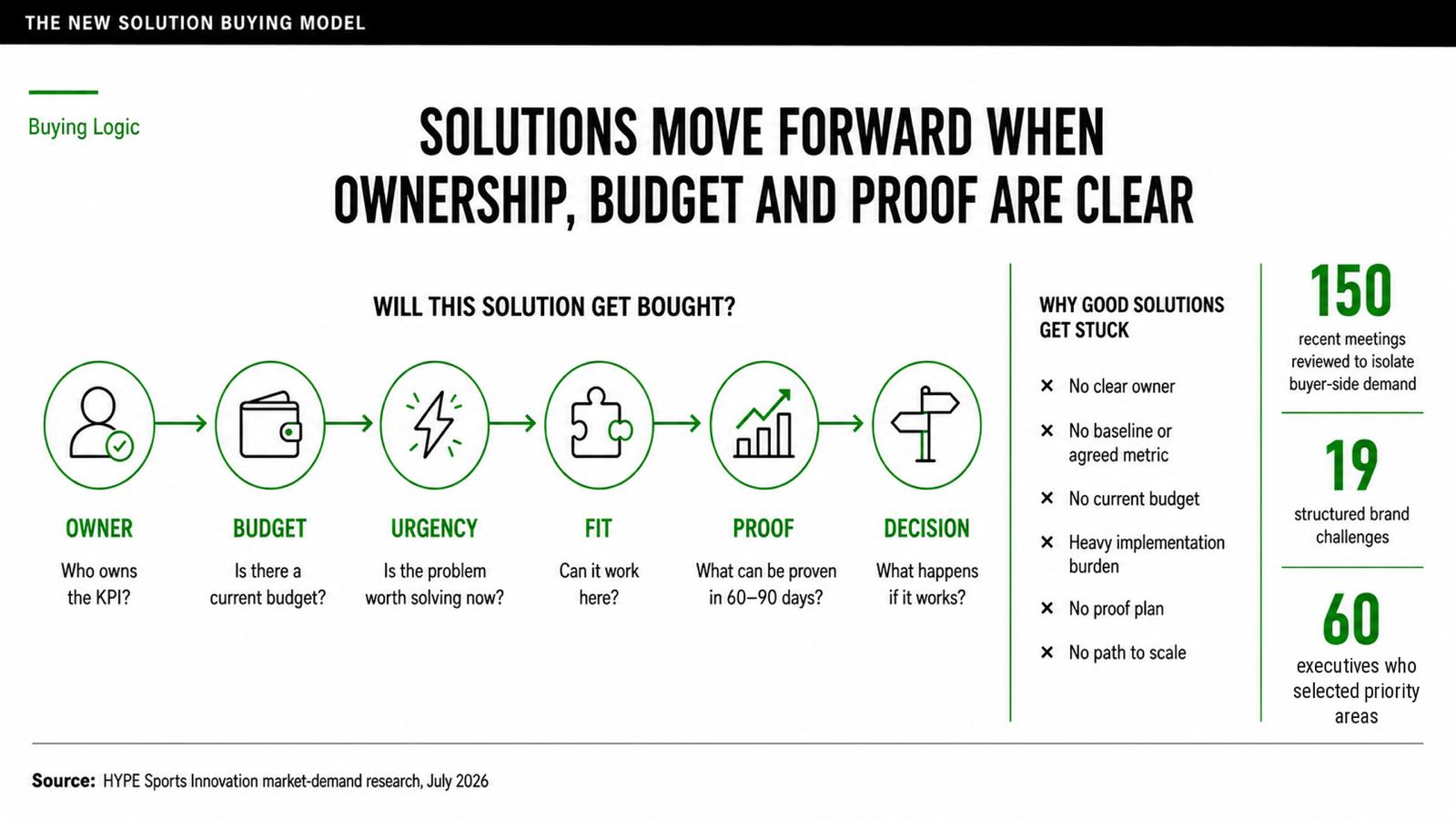
To understand the pattern, HYPE Sports Innovation reviewed 150 recent meetings to isolate genuine buyer-side conversations. We removed startup pitches, broad innovation language, and polite interest that was not connected to a defined need. We then compared what buyers said, selected, rejected, and advanced with 19 structured brand challenges and the priorities chosen by 60 sports executives.
What surprised us was not the volume of interest. It was the consistency of the conditions for action.
Serious buyers kept returning to the same outcomes: revenue, fan conversion, decision intelligence, content efficiency, player availability, sponsorship return, and operational performance.
Once we removed the noise, the signal was clear:
The sports industry’s biggest innovation challenge is a conversion challenge.
Too many pilots. Too little proof.
Too much excitement. Too little ownership.
There is a budget for ticketing, commerce, CRM, content, sponsorship, athlete health, security, and performance.
Few organizations have a meaningful budget called “interesting technology.”
The market is not rejecting innovation.
It is rejecting innovation theatre.
The Technology Worked. The Business Case Did Not.
For years, the industry measured innovation through activity: how many startups entered a program, how many technologies reached the executive team, how many pilots launched, and how many people attended the demo day.
The numbers often looked impressive.
Activity is not impact. A meeting is not a buying decision. A pilot is not an implementation. Enthusiasm is not a budget.
Across the industry, organizations accumulated long lists of experiments and remarkably short lists of scaled deployments.
The technology worked. The presentation impressed the room. The pilot created excitement.
Then somebody asked: Who owns this now?
Too often, nobody had a clear answer. No executive owned the KPI. No baseline existed. No team had committed the required data or resources. No budget had been identified for the next stage. No one had defined what success would unlock.
The pilot succeeded technologically and failed organizationally.
This failure usually begins when the process starts with a solution and searches for a problem afterward.
The new generation of buyers is reversing that sequence. They begin with a real problem, then search across technologies for the strongest solution.
How can we increase revenue from existing ticket inventory?
How can we turn anonymous followers into known customers?
How can we prove the commercial return of a sponsorship asset?
How can we produce more content without increasing costs at the same rate?
How can we reduce manual work, improve player availability, or make better decisions faster?
These are not innovation questions. They are business and performance questions.
And that is precisely why they create budgets, ownership, and urgency.
The Five Shifts Redefining How Sports Buys Innovation
1. From Technology to Outcomes
A Chief Revenue Officer is not buying AI. A performance director is not buying a wearable. A content leader is not buying automation.
They are buying revenue, player availability, better decisions, and more output at lower cost.
Technology has become the delivery mechanism. The outcome has become the product.
“AI personalization for sports” describes a capability. “Increase ticket and merchandise conversion within 90 days” describes a business case.
“Computer vision for elite teams” describes a technology. “Give coaches actionable feedback before the next training session” describes a result.
The technology still matters. Its value becomes visible when it improves something the organization already cares about.
2. From Fan Engagement to Fan Economics
Few phrases have been stretched further than “fan engagement.” It can describe a prediction game, loyalty platform, digital collectible, mobile experience, community feature, or content product.
The phrase has become too broad to guide a buying decision.
Organizations still want stronger fan relationships. They are now measuring those relationships through identity, action, and value.
Did an anonymous follower become a known fan?
Did that fan register, purchase, subscribe, or renew?
Did the experience create useful first-party data or commercial value?
The strongest demand is moving toward solutions that convert fan attention and digital activity into ticketing, retail, hospitality, renewals, and sponsor-driven commerce.
Personalization follows the same logic. Personalized content has limited value when it ends with a view. Its value rises when it leads to a purchase, renewal, upgrade, registration, or partner interaction.
Fan engagement measured attention.
Fan economics measures identity, action, and value.
The new question is simple: What valuable behavior changed because this experience existed?
3. From Pilots to Proof
The pilot was once treated as an achievement. Today, the strongest buyers treat it as a decision mechanism.
Its purpose is to reduce uncertainty and generate enough evidence to choose one of two paths: scale or stop.
A credible pilot needs a named owner, a defined problem, an agreed baseline, a measurable KPI, a realistic integration plan, and a predetermined decision process.
Our research repeatedly pointed to 60 to 90 days as the practical window for generating meaningful early evidence.
This does not mean every transformation ends within a quarter. It means the first quarter should produce a meaningful decision.
A pilot should not prove that the technology functions.
It should prove whether the organization should buy.
4. From Platform Replacement to Intelligent Integration
Sports organizations already operate complex technology environments: CRMs, ticketing platforms, applications, websites, commerce systems, data warehouses, performance tools, and enterprise software.
These systems took years to procure and implement. They support critical workflows and contain sensitive data.
A new product may offer stronger functionality and still fail when adoption requires the organization to replace everything around it.
Buyers increasingly prefer a simpler proposition: create value inside the environment we already have.
This is driving demand for API-first products, plug-ins, overlays, modular tools, and lightweight integrations.
The strongest path often begins narrowly: solve one problem, integrate with minimal disruption, measure the result, earn trust, and expand.
The winning solutions will not demand an organizational reset before producing value.
They will make the existing organization more intelligent.
5. From Excitement to Trust
The first era of sports AI was driven by possibility. The current era is shaped by accountability.
As AI enters customer service, content, commercial decision-making, athlete data, operations, and security, buyers are asking harder questions.
Where does the data come from? Who owns it? How are mistakes controlled? Can a human review the output? Has it worked in a comparable sports environment? What happens when it is wrong?
These questions signal maturity.
Trust has become part of product value.
A powerful product can still fail when the organization lacks ownership, clean data, internal trust, implementation capacity, or a credible route beyond the pilot.
The companies that treat trust as paperwork will move slowly.
The companies that design trust into the product and buying process will move faster.
The 90-Day Proof Standard
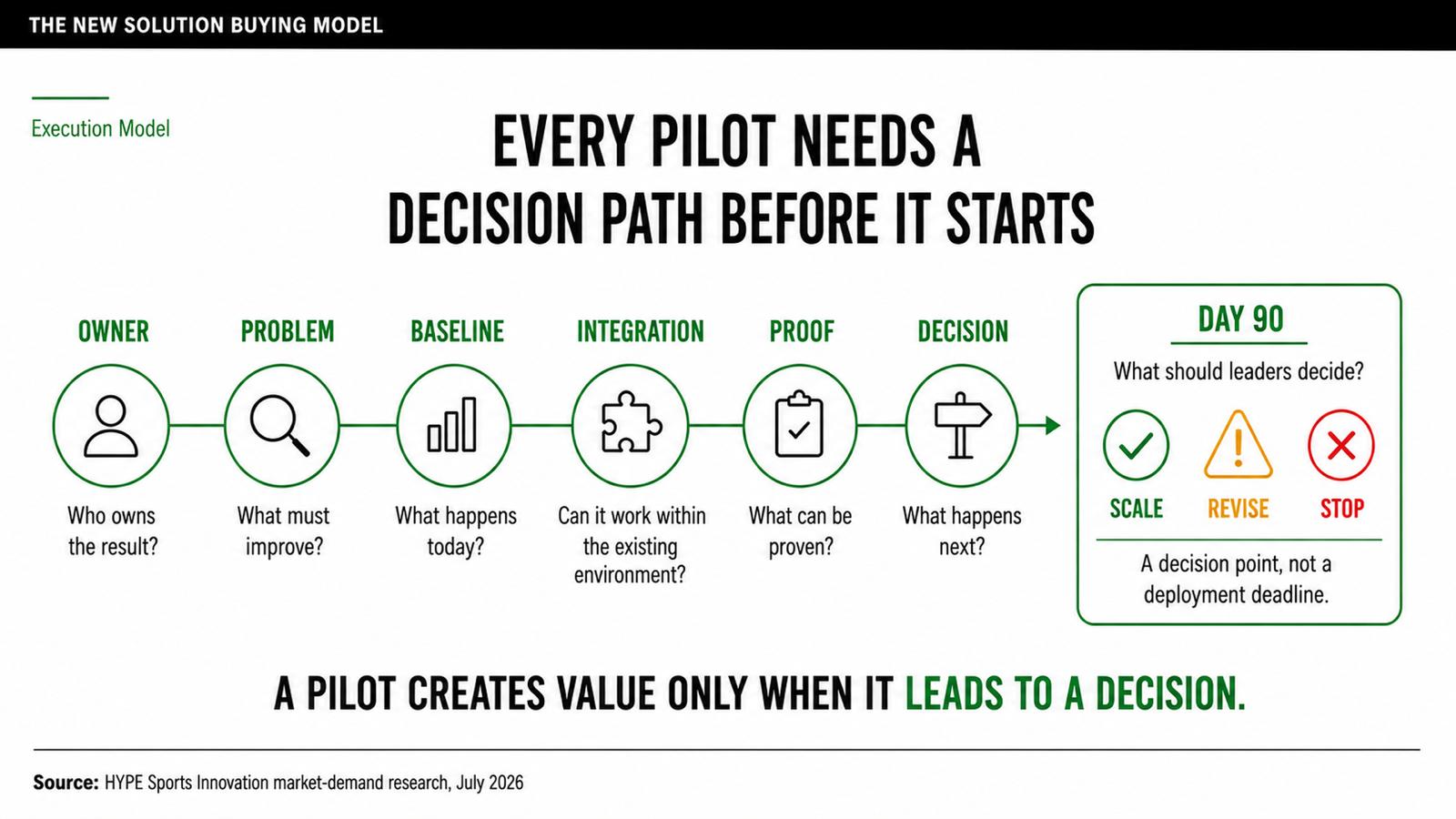
Ninety days is not a universal deployment deadline. It is a decision discipline.
The sports industry does not need another framework for generating ideas. It needs a stronger standard for deciding which ideas deserve to become real.
Every innovation project should be designed to produce a meaningful decision within 90 days.
Six questions define that standard.
1. Owner: Who owns the KPI and has the authority to act on the result? Interest is not ownership. Coordination is not ownership. No owner, no pilot.
2. Problem: What must materially improve? “Improve fan engagement” is too broad. “Increase renewal among season-ticket holders at risk of churn” is a defined problem. Strong challenge briefs begin with the buyer outcome, not the technology label.
3. Baseline: What is happening today? A result cannot be proven without a starting point. The parties must agree on current performance, the target, the data source, and the measurement method before activation begins. Without a baseline, success becomes an opinion.
4. Integration: Can the solution work here, with these systems, people, rules, and constraints? The pilot must test organizational fit alongside product performance. A solution that requires extraordinary internal effort has not demonstrated a scalable model.
5. Evidence: What can be proven within 90 days? Evidence must connect the solution to a result the buyer values: revenue, savings, conversion, retention, efficiency, availability, or decision quality. A dashboard is not evidence unless it changes a decision. Accuracy is not evidence unless it improves a workflow. Engagement is not evidence unless it changes valuable behavior.
6. Scale: What happens when the pilot succeeds? Which team, market, department, or audience comes next? Which budget, procurement, security, training, and integration conditions must be met? A pilot without a path to scale is an experiment. A pilot with a decision path is an investment process.
What Changes Now
For Buyers
Teams, leagues, federations, venues, brands, and rights holders must define the problem before searching for the solution.
Every initiative should begin with the owner, the KPI, the baseline, the operational constraints, and the decision the evidence will support.
The goal is not to meet the greatest number of startups.
The goal is to create the clearest route from an important problem to a defensible decision.
For Builders
Startups and solution providers must lead with the buyer’s result.
“We built an AI-powered platform” describes the company.
“We help sports organizations improve a specific KPI using the systems they already operate” describes the value.
The strongest companies will translate technical capability into buyer language, arrive with a credible pilot design, define the integration burden honestly, and treat evidence and trust as part of the product.
For Innovation Leaders
The role is evolving from technology scout to architect of evidence.
Innovation leaders must connect the executive who owns the outcome, the operational team, the data and technology functions, the solution provider, and the people responsible for procurement and scale.
Their value should be measured through implementation, time to evidence, the percentage of pilots reaching a decision, measurable impact, and expansion.
The innovation function matters when it reduces the distance between a real problem and a proven solution.
Investors should apply the same discipline. A large pipeline of exploratory conversations can be weaker than a smaller pipeline with defined buyers, budgets, baselines, integrations, and measurable pilots.
Interesting is not a buying category.
Final Thoughts

A New Standard Is Emerging
The sports industry is not asking for less innovation.
It is demanding a more credible form of innovation, built around a real problem, a clear owner, a measurable baseline, a low-friction path to deployment, credible evidence, and a defined next decision.
The historic shift is not that more technology is entering sport.
It is that a more disciplined buying model is emerging across the industry.
The winners will not be those running the most pilots.
They will be those that know which problems matter, what evidence counts, and when to scale.
The next era of sports innovation belongs to those who can turn the right problem into measurable proof, and measurable proof into action.
Research Note
This article is based on HYPE Sports Innovation’s review of 150 recent meetings used to isolate buyer-side conversations, 19 structured brand challenges, executive priority selections, pilot activity, and external market-demand signals across teams, leagues, federations, venues, brands, and media organizations. The analysis excluded unsupported startup claims, broad expressions of interest, and activity without a defined buyer need, KPI, or follow-up action.
With the Love for Sports and Innovation,
AR
CEO, HYPE Sports Innovation
P.S.
I want to share something I’ve never done before.
I’m creating “The Board” for a small group of founders who are tired of working hard without growing fast enough.
We’ll focus on the decisions and sales strategy that create real growth in sports.
On August 6, I’ll share exactly how it works and who it’s for. If you’d like to understand how it works, save your spot here.


Comments
Leon
Sports organizations seem much more careful now about which technology actually improves performance instead of buying something simply because it looks innovative. I’ve noticed the same shift personally with fitness gadgets, where real usefulness matters more than flashy features. Before trying a new device, I usually compare experiences on sources like https://fitnus.pissedconsumer.com/review.html to see how it performs outside advertising. Data can help teams make smarter purchasing decisions, but feedback from coaches and athletes still feels equally important. The best products are usually the ones that fit naturally into existing routines and solve a clear problem without making training more complicated.