










63% of Sports Leaders Fear Moving Too Slowly With AI. Yet 54% Still Cannot Prove the Results.
3 Min Read
63% of Sports Leaders Fear Moving Too Slowly With AI. Yet 54% Still Cannot Prove the Results.
At our recent Sports, AI & ROI Showcase, senior industry leaders examined solutions already producing measurable results and surfaced a broader truth: AI in sport is moving quickly, but many organizations are still struggling to turn ambition into impact.
By Amir Raveh, Founder & CEO, HYPE Sports Innovation
At our recent Sports, AI & ROI Showcase, senior industry leaders examined solutions already producing measurable results and surfaced a broader truth: AI in sport is moving quickly, but many organisations are still struggling to turn ambition into impact. Here is what is working, what is holding them back, and why waiting may now be the greater risk.
63% of the sports industry leaders we surveyed believe moving too slowly with AI is the greater risk.
At the same time, 54% said their organisations were still exploring AI without generating measurable results.
Those two findings capture one of the central tensions facing the sports industry today.
Leaders understand the importance of AI. The urgency is already there.
The harder question is how to turn that urgency into measurable business value.
That was one of the clearest lessons from our recent Sports, AI & ROI Showcase.
The conversation has changed
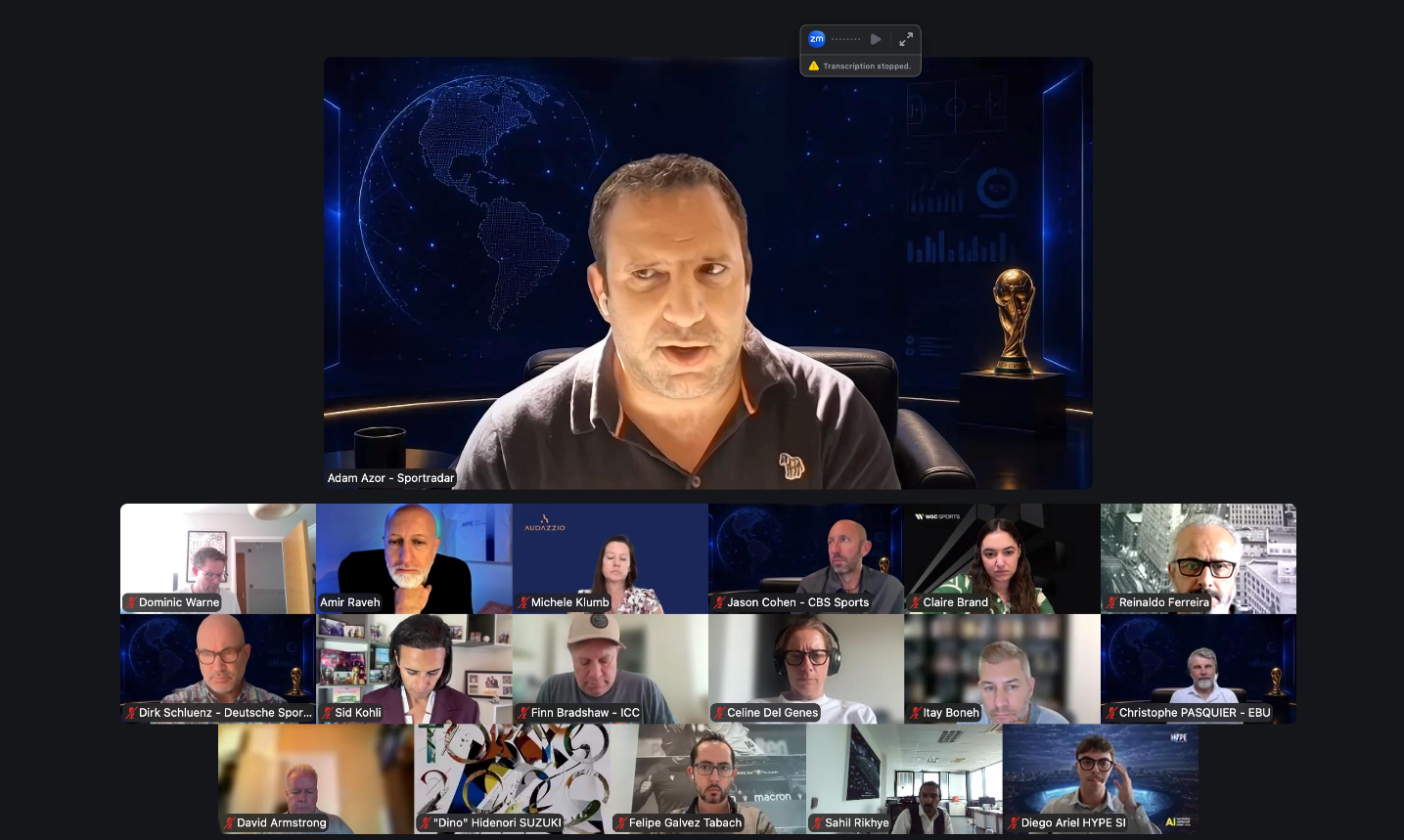
We originally imagined a small, focused session. More people joined than we had planned for, bringing together senior leaders from sport, media, investment and technology.
But the size of the room was not the important part.
What mattered was the nature of the discussion.
Leaders were no longer asking whether AI would eventually influence sport.
They wanted to know where it is already working, how results are being measured, what implementation really requires, and why some organisations are moving from experimentation to value while others remain stuck in pilot mode.
The conversation is becoming less theoretical and far more practical.
The balance of risk is shifting

During the session, we asked two simple questions.
Is your organization currently using AI to drive new revenue or improve performance?
46% said they were already generating measurable results.
54% were still exploring opportunities without measurable results.
We then asked:
What is the greater risk for sports organisations today?
63% selected moving too slowly.
37% selected moving too fast.
I expected more caution.
For years, much of the AI conversation has focused on the risks of moving too quickly: privacy, security, inaccurate outputs, governance and reputational damage.
Those risks are real and must be managed.
But leaders are becoming increasingly aware of the risk on the other side.
The risk of waiting while competitors test and learn.
The risk of delaying until the capability gap becomes difficult to close.
The risk of preparing for a game that has already started.
“In sport, the right decision made too late is still the wrong decision. That is the real cost of inaction with AI.”
Moving carefully is sensible.
Standing still is also a decision.
Start with the business outcome
One of the strongest examples during the session came from Webout.
The company showed how its technology had helped brands generate tens of millions in new revenue.
What made the example powerful was not the technology alone.
It was the clarity of the outcome.
The questions immediately became practical:
How was the result measured?
How long did implementation take?
What had to change inside the organisation?
Could the same model work elsewhere?
That discussion reinforced a principle I believe more strongly than ever:
Do not start with the AI. Start with the business outcome.
“Where can we use AI?” is usually too broad a question.
A better starting point is:
What problem are we trying to solve?
What result are we trying to improve?
What would success look like in measurable terms?
AI becomes valuable when it is connected to a real business need.
The hidden barrier is often cultural
Better technology matters.
So do data, budgets, governance and technical capability.
But the greatest barrier is not always technological.
Often, it is organisational behaviour.
“Cultural resistance is not always loud. Sometimes everyone agrees in the room, then returns to work exactly as before. That silent resistance is what makes it so dangerous.”
This is why AI transformation can appear more advanced in presentations than it is in daily operations.
A pilot is approved.
A working group is created.
The leadership team agrees that AI is important.
But priorities, incentives and ways of working remain unchanged.
The organisation has launched an AI initiative, but it has not changed how it operates.
Real adoption requires clear ownership, honest measurement and a willingness to change established behaviour.
Evidence turns attention into action
The companies selected for the Showcase presented solutions across revenue, fan engagement, customer experience, content, operations and performance.
On average, each company received around ten requests for follow-up conversations.
That does not mean ten deals. There is still a meaningful distance between interest, a serious commercial discussion, a pilot and a long-term partnership.
But it provides a useful signal.
Sports organisations engage when they can see:
• A relevant business problem
• Evidence of measurable value
• A credible route to implementation
• A result that can be tested and scaled
The standard is rising.
A broad claim about the potential of AI is no longer enough.
Final Thoughts

Three questions worth asking
Before launching another AI initiative, every organisation should answer three questions.
1. What measurable outcome are we trying to change?
Revenue, conversion, retention, productivity, cost, fan data or performance.
Choose the outcome before choosing the technology.
2. What can we prove within 90 days, and who owns the result?
The first test should be focused enough to move quickly and meaningful enough to support a real decision.
Someone from the business must own the outcome.
3. What happens if it works?
The route from pilot to implementation should be considered before the pilot begins.
A successful experiment without a clear next step creates activity, not transformation.
The next phase of AI in sport
The next stage of AI in sport will not be defined by who runs the most pilots or makes the boldest announcements.
It will be defined by who learns most effectively.
Who chooses the right problems.
Who measures honestly.
Who stops what does not work.
And who scales what does.
For us at HYPE Sports Innovation, this is the work: helping the industry move from curiosity to evidence, and from evidence to implementation.
The urgency is already there.
The challenge now is building the discipline, ownership and culture required to turn it into measurable value.
The game is moving. The question is whether our organisations are learning quickly enough to move with it.
P.S. Following the success of the first event, we’re holding another Sports, AI & ROI Showcase on August 6.
If you’d like to receive an invitation, please leave your details HERE.
The findings are based on live audience polls conducted during the Sports, AI & ROI Showcase.
With the Love for Sports and Innovation,
AR
CEO, HYPE Sports Innovation


Comments